With the introduction of crypto assets into estate planning, there are new challenges emerging for Trust & Estate teams at firms globally. The learning curve for both the technology and an entirely new asset class is high, and clients are increasingly likely to have crypto assets as part of their overall investment portfolio.
How Are Crypto Assets Different Than Traditional Assets?
Typical assets have a location and are retrievable, crypto assets, whilst they live on the blockchain can have a variety of ways to access them - so you need a full and complete inventory which is always kept up to date and you need the access instructions - this is hard.
1. Cryptocurrencies do not inherently have to be held by a custodian, which is something that is not typical of most other types of asset classes. As a result, it can be extremely difficult to maintain an accurate inventory of a client’s crypto assets over the years of their life.
2. There is no custodian for any crypto assets that the client self-custodied, there is also no third party to help trigger the process of transferring the assets upon the passing of the client.
3. Since self-custodied crypto assets are not present in the physical world and are also not maintained in a consistent record by a custodian, it is much more likely that they can simply go unaccounted for.
4. Crypto assets - even if documented in a an inventory need access instructions - especially when the assets are spread across multiple wallets. The next of kin and executor may not be able to access the assets if a plan was not kept up to date and meticulously reviewed over the years.
This leads to the risk that crypto assets can become lost or stolen, which carries a serious risk for Trust & Estate teams who attempt to undergo digital asset estate planning without being properly equipped to handle a new class of assets.
Key Risk Highlights For Clients
In addition to the usual risks for clients when it comes to estate planning, crypto assets bring an additional set of risks into play that firms need to be aware of and remain prepared to address:
- The risk of an incomplete or inaccurate list of inventoried crypto assets, resulting in lost assets.
- Access risk, specifically when trusting third parties with digital asset risk. Providing asset access to the wrong party can result in asset loss, leaving firms open to liability.
- The privacy and security of the client, their assets, and their information within the firm. When information is written down, it can be accessed by multiple people - this is a privacy risk, one that carries with it the potential of loss of the asset entirely.
Without specifically considering these risks for crypto assets, most firms are ill-prepared to assist clients with the protection and security that is required when handling the inheritance of crypto assets.
What Do Firms Need For Traditional and Digital Inheritance At A High Level?
Regardless of whether the firm plans on assisting clients with traditional assets, crypto assets, or a combination of both, there are some core planning requirements that they should be considering. The manner in which the firm conducts these steps will vary, depending on whether the assets in question are traditional or digital:
- Identifying the beneficiaries of the client.
- Creating a legally binding will for the client.
- Writing, as well as maintaining, instructions that detail how to transition the client’s assets.
- Contracting for a form of storage to help protect the client’s inheritance plans.
- Creation of an asset inventory, especially for crypto assets.
What Could Happen Without Proper Digital Asset Planning?
There are a plethora of these examples happening with worrisome regularity:
In December 2018, Gerald Cotten, the founder of Canadian Bitcoin trading exchange QuadrigaCX, died (under somewhat mysterious circumstances) resulting in the loss of $250M and the exchange going bankrupt. Gerald was only 30 years old and had not created an inheritance plan, nor were instructions of how to access the centralized assets ever found.
In April 2018, Matthew Mellon, heir to Mellon family banking fortune and former chairman of the NY Republican Party finance committee, and cryptocurrency proponent died. Prior to his death, he held an estimated $1B in Ripple (XRP) - all of this remains inaccessible as he left no instructions, even though he protected the cryptocurrency via cold storage in multiple locations around the US in different people’s names.
In 2017, an unidentified young crypto investor in Colorado died with a small fortune in cryptocurrency held in a Coinbase account. The family, however, had no access to the account, and had to petition Coinbase directly. Eventually, the assets were released after a lengthy process. If the account holder had not been a U.S. Citizen, this would have been a much more complicated process.
How Can Vault12 Help Firms to Manage Digital Asset Inheritance?
Vault12 is the pioneer of crypto inheritance, the company was founded in 2014 just as crypto assets (Bitcoin) started to become talked about. Vault12 Digital Inheritance, launched to Apple and Google app stores in 2019, is the first solution to offer a simple, direct, and secure method for all investors to ensure their crypto assets are available to future generations.
Traditional approaches to asset inheritance, when applied to crypto assets, introduce complexity and risk.
A crypto asset portfolio is continually changing. It is not possible to rely on doing an inventory once, or for that matter, continually, without assistance.
Vault12's simple Digital Vault solution with trusted Guardians accommodates all types of crypto assets and reduces the uncertainty around assets not being available to the designated recipient. It also avoids having to approach and petition each service individually during probate to gain access.
How Does Vault12 Digital Inheritance Work?
The Vault12 Digital Inheritance solution provides an app for protecting, backing up, and securing clients' crypto assets. It enables the client to designate a beneficiary who can inherit their entire portfolio of crypto assets stored in their Vault when the time comes. With Vault12, there is no need to continually update an inventory or to issue updated instructions.
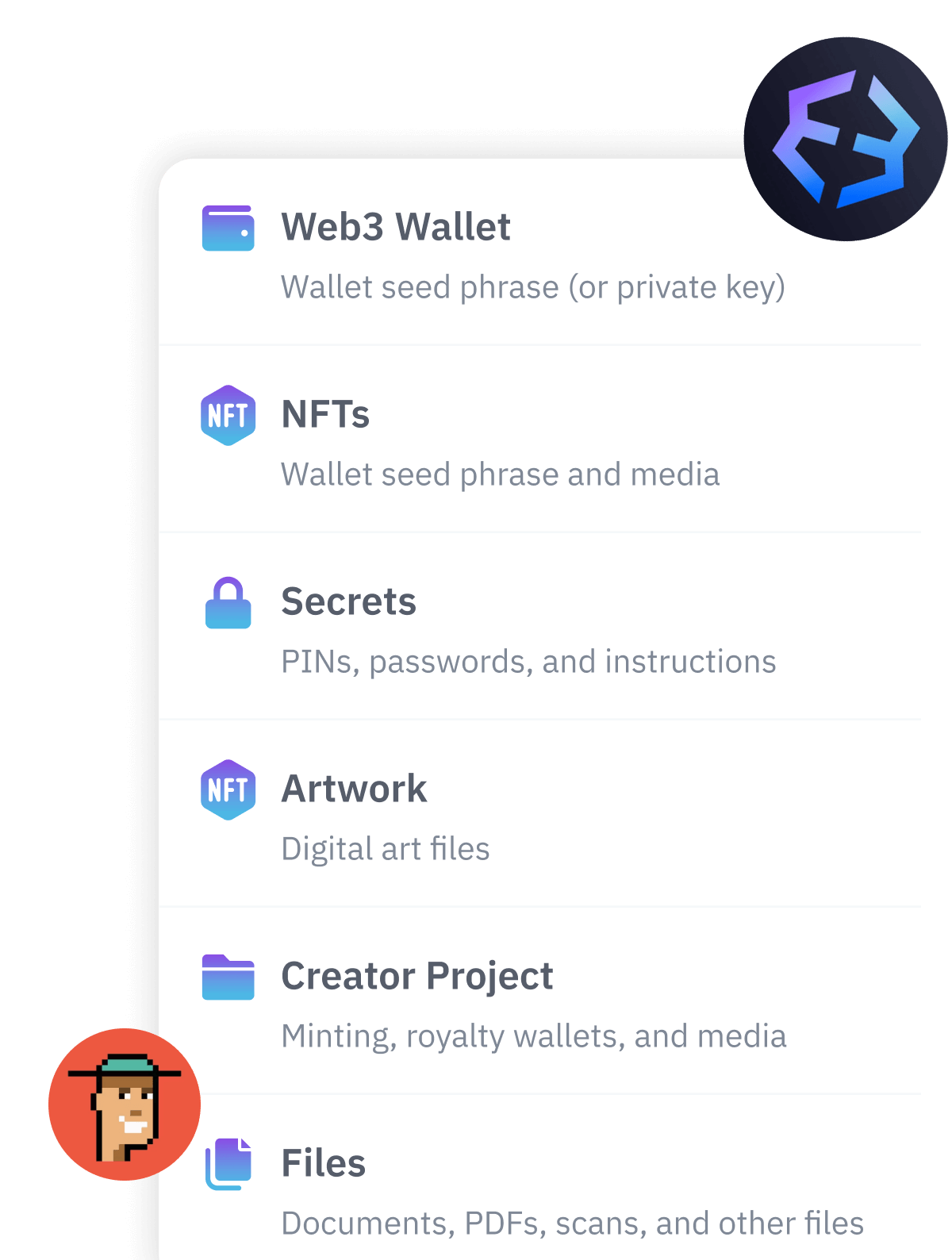
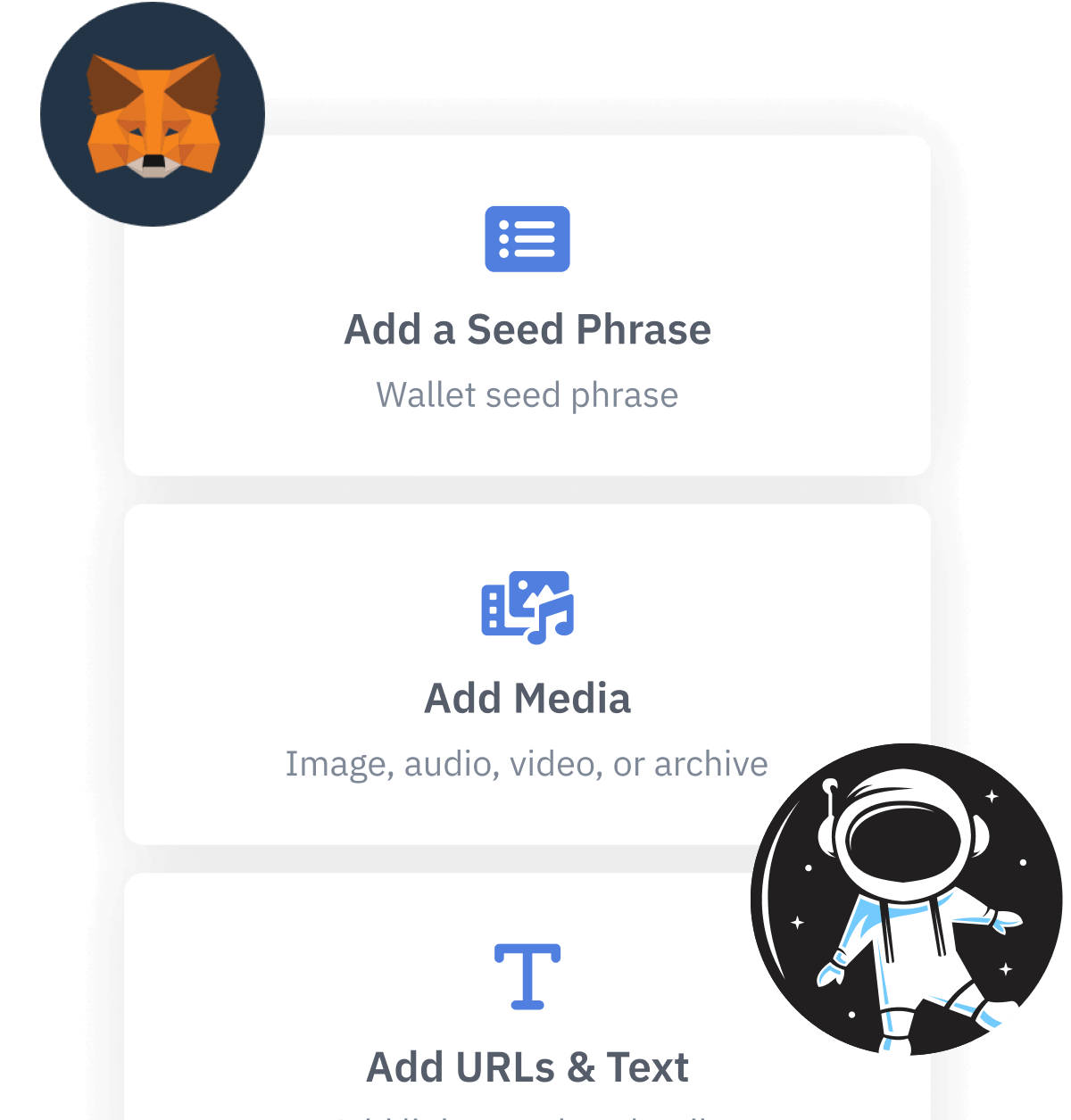
Crypto assets, including cryptocurrency, financial login information, legal documents, medical records, and more, can be added to a Vault12 Digital Vault.
The Vault is protected by a network of Guardians. Guardians are friends, family, and business associates of the client. The firm can also be designated as a Guardian on behalf of clients. Additional resources for assisting clients in choosing their Guardians can be found here.
A beneficiary is designated by the Vault owner from amongst the Guardians, and a declaration is digitally signed and transmitted to the beneficiary and lawyers as needed.
Upon the passing of the Vault owner, when the beneficiary is ready to access the crypto assets, a designated number of Guardians approve the request, and the assets are restored with access granted to the beneficiary.
Should the beneficiary attempt to access the assets before the owner’s passing, the owner can veto the request.
How Can Vault12 Help Maintain a Digital Asset Inventory While Maintaining Privacy?
Vault12 Digital Inheritance was designed to reduce the risks associated with managing crypto assets and preparing them for future transfer: backed up by distirbuted decentralized technology infrastructure that protects privacy and quantum-safe cryptography to ensure only the right person can see this information.
- Comprehensive Digital Asset Inventory: Designed to accept all forms of crypto assets. When used to secure and back up an investor’s full range of assets, it provides an up-to-date inheritance inventory.
- Direct access for the designated individual: Offers a simple and direct way for the designated individual to gain access to crypto assets without having to petition multiple services or financial institutions.
- Privacy: Ensures that, unlike with multi-sig solutions, information about the crypto assets is kept private, even from the firm, while still allowing the firm to assist in the process.
What Digital Asset Risks Exist for Beneficiaries?
In traditional trust and estate planning, an executor ensures that the client’s beneficiaries receive the assets specifically designated for their inheritance at the appropriate time. Just as an executor ensures that these traditional assets are transferred at the appropriate time and no sooner, a robust plan for crypto assets must also exist to ensure that a similarly appropriately timed transition occurs for the client.
Let’s highlight some beneficiary risks and how Vault12 Guard can assist the firm in handling them for clients with crypto assets.
Example 1: If the intended beneficiary is given direct access to the client’s crypto assets today, they are free to access those assets immediately. Furthermore, anyone who happens to stumble upon the access directions given to the beneficiary could also achieve inappropriate access to client assets.
Example 2: If the lawyer representing the firm or executor of the will is given immediate access to the client’s crypto assets, they take on a variety of third-party risks, such as loss or theft due to improper security, closure of the firm, or seizure of the assets.
Vault12 Guard brings beneficiaries into the process of estate planning without the risk that they can access assets before they are supposed to. It also allows for custodial access to client assets without such centralized third-party risk, helping to create less liability to the firm for handling crypto assets.
What Digital Asset Risks Relate to Writing and Maintaining Instructions?
Crypto assets are not all the same. A client’s crypto assets could include works of art, fungible cryptocurrency tokens, important documents, and other real-world assets, or a combination of these. Accessing these assets could vary as well, based on where the asset is stored, how the asset is stored, and maintaining a ledger of all of the seed phrases, pin codes, passwords, and other access information for the client’s crypto assets.
As with beneficiaries, Vault12 Guard can help mitigate these risks for firms.
Example 1: Key access information for client assets could be documented incorrectly or omitted, leading to loss of asset access.
Example 2: The firm forgets to update the list of client crypto assets or access information frequently enough.
Example 3: The ledger of assets and access instructions is maintained perfectly, but falls into the wrong hands.
Vault12 Guard can help simplify asset access instructions, despite the ability of digital asset portfolios to change frequently. It also helps to mitigate centralized access risk by spreading out the responsibility of keeping access to the crypto assets safe.
What Risks For Crypto Assets Relate to the Storage of Digital Inheritance Instructions?
Traditional asset storage for financial assets has historically been handled by a custodian, like a brokerage firm, that works with the firm on behalf of the client and assists with transitioning those assets upon the passing of the client. Physical assets are typically stored within some type of safety deposit box or another custodial solution.
Example 1: Access to safety deposit boxes for digital inheritance instructions is not always available, nor are they always insured in the event of loss or theft.
Vault12 Guard’s app is a more secure location to hold access instructions for client digital asset inheritance than a physical location like a safety deposit box.
How Does Vault12 Guard Help Firms Manage Digital Asset Inheritance Risk?
The previously mentioned risks, both to the client and to the firm, can seem overwhelming when discussing digital asset inheritance. Firms can look at these assets as an extra hurdle to have to overcome for clients, with a learning curve that is fraught with liability for the firm if proper precautions aren’t taken and shortcomings occur in just one of a number of areas, as highlighted above.
As digital asset adoption continues to grow, the ability to plan for the future is becoming more complex. There is a definitive learning curve associated with the adoption of crypto assets, and more estates will likely contain Bitcoin and other crypto assets as the adoption of this asset category matures in the future.
Many centralized exchanges do not currently offer sufficient options for succession, and digital asset holders also do not have to keep their assets with a custodian, as they would with traditional assets such as stocks or bonds. While technological innovation for self-custody of crypto assets is one benefit to the asset class, it also adds complexity when it comes to transferring assets to the beneficiary upon the owner’s passing.
Traditional paper wills and trusts are not enough to ensure the successful transfer of crypto assets. This is the case for several reasons, including encryption barriers, two-factor authentication, lost or misplaced hardware wallets, and a variety of other factors. Fortunately, Vault12 can help not only mitigate these concerns but also serve as a differentiator for lawyers when it comes to advising clients on digital asset inheritance.
How Does Vault12 Change Inheritance Advisory Options?
The technology underlying Vault12 helps to create a simpler experience for legal professionals seeking tools to advise clients on digital asset inheritance.
Vault12 Guard encrypts private information utilizing cryptographic technology in a manner that is Quantum-safe by splitting the encrypted information into various pieces (referred to as shards).
The user can choose the number of shards to create from their data, as well as how many shards need to be recovered to recover access to the wallets. This is a decision that a legal professional could assist their client with, as the client will need to select a handful of trusted confidants with whom to trust their cryptographic shards, known as guardians. Lawyers themselves can be a Guardian, and we will get into why that’s a better role than other options.
This guardian concept is a more secure option for inheritance than previous password-protected models. It has been shown time and time again in crypto that having private wallet keys be password-protected, even in a password manager, is a major liability. The password serves as a single point of failure, and once that password is cracked by bad actors, every wallet whose private keys were listed is compromised.
Some use a multisig wallet to help decentralize the risk of access. Multisig is short for multiple signatures, which means that the risk of a singular access point is spread out across multiple fractional access points. While decentralization of risk does help to ensure a higher level of safety for crypto assets, how the data is decentralized makes a big difference. Simply ensuring that no one centralized server has all of the data needed to access the assets is only the first step.
Multisig wallets are only an option for a small subset of crypto assets. Anything that is not close to the very top of the adoption curve is likely not going to be accessible through a multisig wallet. Furthermore, separate software is required to run a multisig, as it is necessary to be able to field signatures from all wallet holders upon activation. Vault12 Guard does not have this potential downtime liability. The shards that are created can always be used to access the underlying data with no need for any additional software to be run in parallel to Vault12 Guard or any other integrator.
Why Should Legal Professionals Choose Vault12?
Historically, if a crypto asset holder came to a law firm seeking counsel for how to pass on their assets to their beneficiary, it was extremely important that someone within the firm specialized in this type of asset class. The fact that crypto assets can be self-custodied, which is not the case in most other asset classes as of the writing of this article, created a major learning curve for anyone who wasn’t already deeply immersed in the world of crypto and blockchain technology.
The biggest problem with taking this type of work has been the legal liability if something happens to the assets after the firm has been provided access to them. Previously, the only way to entrust asset access to anyone was to provide them with the private keys (often in the form of a seed phrase) to each digital wallet. This is a highly insecure practice and opens up law firms providing this type of service to massive liability should assets be stolen or lost.
Vault12 Guard helps to mitigate this risk by providing the options for the firm or lawyer to serve as a Guardian of the assets. Guardians are trusted individuals or entities to the user/client who hold a cryptographic shard, as discussed earlier. Guardians are typically only provided with a singular shard, meaning that any individual Guardian can’t access the crypto assets entrusted to the vault because they don’t have a majority share of the vault’s shards.
This helps to mitigate internal fraud since the firm and its employees can’t unilaterally access client assets. It also creates a mechanism where a legal professional (and their shard) is needed to help approve a restoration of the vault and enable access to any third party trying to claim inherited crypto assets, so long as the firm is a Guardian. Creating this technical integration of requiring the firm to review also helps to initiate the probate process directly into the unlock flow of the vault. It is assumed that if the firm is going to provide access to its shard, it believes that the claim against the crypto assets is valid and legal.
How Can Firms Onboard Clients to Vault12?
The process of utilizing Vault12 to help secure and pass along client assets is relatively straightforward.
- An initial meeting will need to be set for the firm to help the client create a Vault12 Digital Vault,
- Help import their wallets, based on an inventory
- Choose their Guardians. Examples of potential Guardians include the firm itself, a spouse, adult children, and other trustworthy individuals.
- Designate one of the Guardians as a beneficiary.
The Vault12 website has multiple onboarding articles for clients that can assist, including this one.
Once the initial setup is created, there is a (hopefully) long dormant period between setting up the infrastructure and the passing of the client, triggering the need for beneficiaries to access their crypto assets.
The beneficiary will request access upon the client’s passing, at which point, Guardians will review the request, and enable authorization to their Guardian shard. Once enough shards have been enabled, the beneficiary can access the assets directly, bypassing the complexities that can occur with custodied assets being willed.
What are the Strategic Benefits of Vault12 for Firms?
Not only does utilizing Vault12 help to mitigate centralized risk for firms by helping to prevent fraud or lost assets, but it can also be used to help generate upside for the firm itself.
Take the dormant period, for example. Over the course of the (hopefully) years between enabling the client’s vault and their eventual passing, it will be necessary for someone to check on the vault, its access, and ensure that everything is still operational for when the beneficiary ends up showing up to claim the assets. This creates an opportunity for firms to create a recurring revenue course by having clients retain them for these spot checks on their vault. It also makes the burden of changing law firms higher, given the firm’s role as an established Guardian of the client’s crypto assets. This type of deepening of the client relationship not only helps retention but could also lead to additional business from the client over the course of their lifetime.
The reputational boost to the firm should also be considered. As previously mentioned, crypto assets have historically been so specialized during their infancy as an asset class that many firms lack the technical and practical understanding to service clients who hold crypto assets effectively and safely. High-net-worth and tech-savvy clients, who can account for a lot of business for firms, are therefore in need of technically competent service providers who can handle their specific needs. Due to the recency of crypto assets coming on the scene, there is not a large number of established players who have a reputation for being highly technically skilled in serving clients in this vertical. Vault12 allows firms to differentiate themselves from their competition by making the process smoother, safer, and more automated than ever before.
Where Does Vault12 Offer Value to Firms?
The Market Shift: The rapid increase in estates containing Bitcoin and cryptocurrency assets, and high-value digital accounts.
The Failure Point: Most exchanges offer minimal succession options and involve significant long-term counterparty risk. While asset holders prefer non-custodial crypto storage, this introduces complexity, costly security and operational measures, and potential for lawyers’ liability. Traditional paper wills and trusts are often ineffective for transferring crypto assets due to encryption barriers, 2FA, hardware wallet loss, and other issues.
The Opportunity: The ability to secure digital legacy is not just a technical fix; it’s a premium service differentiator for modern law firms.
The Lawyer as the "Professional Guardian"
New Service Model: specific role of the attorney within the Vault12 ecosystem. The firm acts as one of several "Guardians" required to unlock the Vault.
Liability Mitigation:
The Problem: Lawyers or firms holding private keys/hardware wallets assume massive liability (theft/loss risks).
The Solution: As a Vault12 Guardian, the lawyer/firm holds only a fragment of the key. They cannot access funds unilaterally (preventing internal fraud) but are required to approve the restoration (ensuring legal compliance).
Probate Integration: a technical "check-and-balance" that mirrors the legal probate process.
Operational Workflow: From Setup to Succession
Phase 1: Onboarding: The firm assists the client in creating a digital vault and assigning Guardians (e.g., Spouse, Law Firm, Adult Child).
Phase 2: Dormancy: The system operates autonomously; the law firm requires only a monthly health check for maintenance.
Phase 3: Activation (The Event):
- Upon client death, the beneficiary requests access.
- Guardians are contacted via the app.
- Assets are restored directly to the beneficiary, bypassing complex exchange probate.
Strategic Benefits for the Firm
Recurring Revenue: Potential for retainer models based on "Digital Guardianship" maintenance.
Client Retention: "Guardian" status necessitates a long-term, active relationship between the firm and the client/heirs.
Modernization: Establishes the firm as technically competent to handle high-net-worth crypto and tech-savvy clients, a demographic often underserved by traditional estate planners.