
Contents
Wallets vs Vaults — which is better?
What is the difference between Wallets and Vaults? Do you need both? In this article, we'll dive into their key differences and why you need both for backup and inheritance.
What is the difference between a Wallet and a Vault?
What is a crypto wallet? You can set up a crypto wallet to interact with blockchain networks in order to send, receive, buy, and sell cryptocurrency. Your wallet uses a unique, secret private key to digitally sign your transactions on the blockchain, proving that it's really you authorizing transactions. In other words, you use your crypto wallet to perform your crypto transactions on a blockchain network.
A vault, on the other hand, is completely inert. It's completely separate from your blockchain activity. No transactions are going on. It's simply a place to store valuable things like seed phrases, passwords, private keys, and digital art.
So a vault is completely different from a wallet in some major ways:
- Security — A digital vault is significantly more secure. It prioritizes long-term security, and is ideal for digital inheritance.
- Accessibility. Wallets are used for day-to-day crypto transactions. Vaults are more appropriate for preserving your digital assets for inheritance and ensuring that heirs can securely access them when the time comes. Vaults maintain long-term accessibility to your crypto.
What is the Vault12 app?
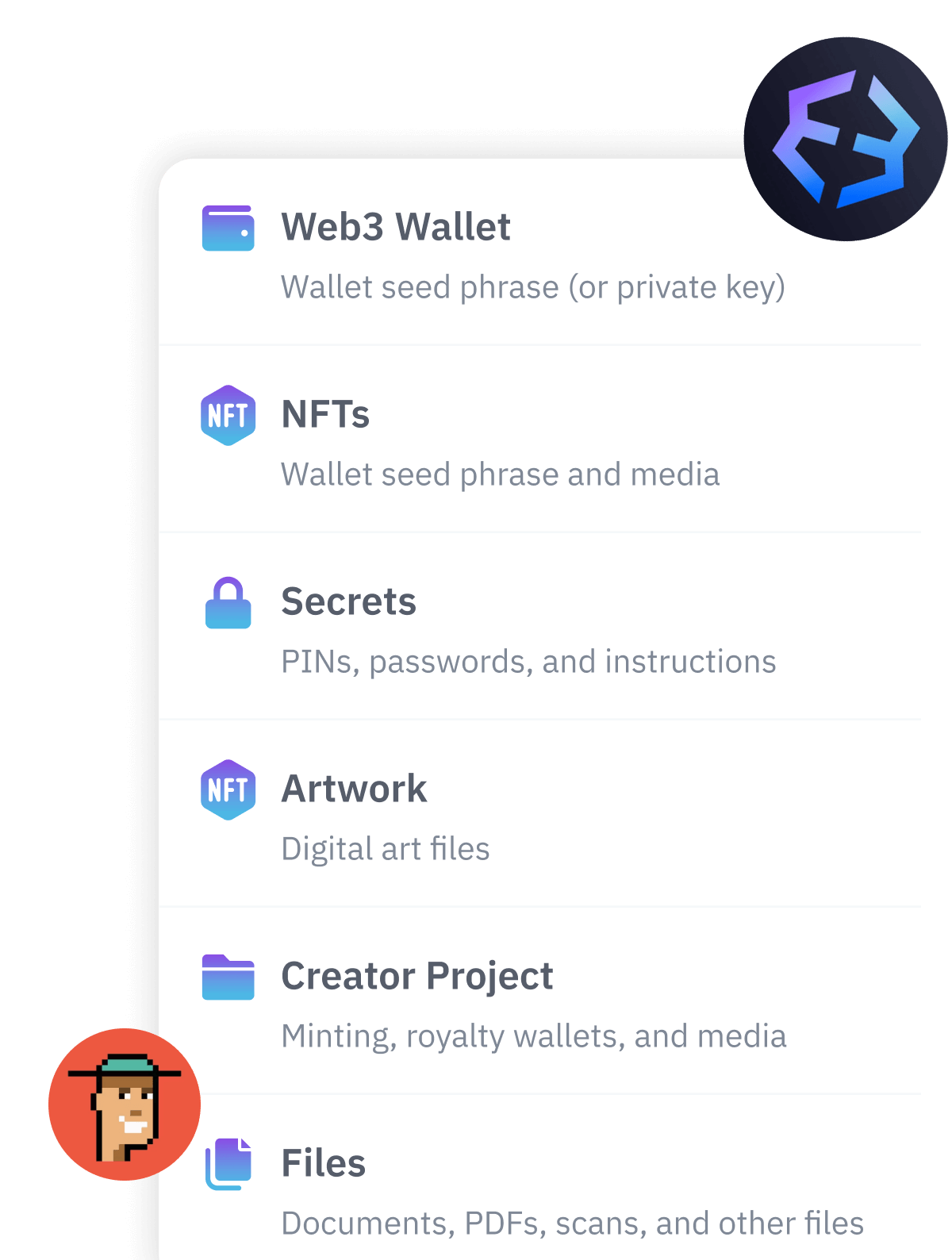
The Vault12 Guard app is an intelligent digital vault that can back up and support the inheritance of your digital assets like passwords, PINs, seed phrases, private keys, files associated with your NFTs, and digital artwork. It safeguards basically everything that you know and love in the world of crypto.
Why do you need both a wallet and vault?
There are three reasons why you should have both a wallet and a vault for your digital assets.
- The first reason is backups. It's very important that you've backed up your precious assets, whether they're PINs, passwords, seed phrases, or artwork. Everything should have a backup that is available to you should you need to access it.
- The second reason is inheritance. It's very easy to lose track of assets that you need to pass on to the next generation. Having a single inventory in one place with all of your digital assets, all of the instructions, PINs, passwords, seed phrases, private keys, and digital artwork that you want to pass on in the case of incapacitation, or when you pass, and having a mechanism to smoothly transfer them is really important. This is not something you can do with a wallet.
- The third reason is that centralized custodial services are prone to loss. We've seen this time and time again over the last decade. Custodial services are susceptible to fraud and hacking. They're subject to companies going bankrupt and users losing all of their assets. In contrast, the Vault12 app provides a distributed, self-custody backup.
Wallets vs Vaults — which is better?
What is the difference between Wallets and Vaults? Do you need both? In this article, we'll dive into their key differences and why you need both for backup and inheritance.

Wasim Ahmad
Wasim Ahmad has spent decades at the exact point where deep, difficult technology meets everyday people.
It started early. As a schoolboy in Britain in the 1970s, he was among the first children to learn Prolog, the artificial intelligence language. He went on to the University of Sussex to study Mathematical Physics, then switched to Physics and French so he could spend a year in Paris — an early sign of a career that would keep crossing between the technical and the human. After university, he was an astronaut candidate with the Juno Project, but was too young to be allowed into space.
In the 1990s he joined Synon, the British startup whose software-based code generation won the Queen’s Award for Technology, moving with the company to Marin County, California.
As a founding member of Voltage Security, a Stanford University spinout, he launched the first commercial email encryption built on Identity-Based Encryption — the first genuine breakthrough in public-key cryptography in thirty years — working alongside some of the world’s most renowned cryptographers, including Stanford’s Dan Boneh. When catastrophic breaches hit the payments industry, he helped launch end-to-end protection for the world’s payment systems using format-preserving encryption.
His crypto journey began with AlphaPoint, working with the founding team that launched some of the world’s first cryptocurrency trading exchanges. He then joined Vault12, the pioneer of crypto inheritance, where the mathematics of Adi Shamir’s Secret Sharing — became a product that lets people pass their digital assets safely to the ones they love.
Most recently, he has been lobbying hard in both the United States and the United Kingdom — engaging with the SEC, CFTC and the FCA — to evolve the laws and regulations governing crypto, so that everyday people can access these technologies safely and confidently.
He is now the author of a book on everyday cryptography: "Who holds the key?", an everyday guide to cryptography, passwords, crypto wallets, and navigating the technology that protects your privacy in the modern world.
The pattern across all of it is the same one that drives his book: taking complex technology and formidable algorithms, and shaping them into solutions that ordinary people can trust, understand, and use.
Wasim served on the board of non-profit, StartOut, and is a Seedcamp and WeWork Labs global mentor.
Wasim graduated with a Bachelor of Science in Physics and French from the University of Sussex.

Prepare for the future - Don't lose your crypto when you die...
...unless you set up Crypto Inheritance today.
It's simple — if you don't worry about crypto inheritance, nobody else will — not your software or hardware wallet vendors, not your exchanges, and not your wealth managers. So it's up to you to think about how to protect the generational wealth you have created, and reduce the risks around passing that crypto wealth on to your family and heirs. What are the challenges with crypto inheritance?
- Crypto Wallets are difficult to use and do not offer crypto inheritance management. In fact, most of them tell you to write down your seed phrase on a piece of paper, which is practically useless.
- Some people back up their wallet seed phrases or private keys on paper, local devices like hardware wallets or USBs, or in the cloud. All of these options have severe drawbacks that range from hacking to accidental loss to disrupted cloud services.
- Software wallets operate on specific blockchains, yet your crypto assets span multiple blockchains. For inheritance to work, you must be able to manage inheritance across every blockchain — now and forever.
Pioneering Crypto Inheritance: Secure Quantum-safe Storage and Backup
Vault12 is the pioneer in Crypto Inheritance, offering a simple yet powerful way to designate a legacy contact and pass on your crypto assets—like Bitcoin (BTC), Ethereum (ETH) and Solana (SOL) —to future generations. Built for everyday users yet robust enough for the most seasoned crypto enthusiasts, Vault12 Guard ensures your wallet seed phrases and private keys are preserved in a fully self-sovereign manner, across all Blockchains.
At the heart of Vault12 Guard is quantum-resistant cryptography and a decentralized, peer-to-peer network of trusted Guardians. Your critical information is never stored in the cloud, on Vault12 servers, or even on local devices—dramatically reducing the risk of a single point of failure. By fusing a powerful software layer with the Secure Element of iOS devices (Secure Enclave) and Google devices (Strongbox), Vault12 Guard locks down your private keys against present and future threats.
Our innovative approach harnesses social recovery, enabling you to appoint one or more trusted individuals or mobile devices as Guardians. These Guardians collectively safeguard your protected seed phrases in a decentralized digital Vault—so there’s no need for constant lawyer updates or bulky paperwork. Should the unexpected happen, your chosen legacy contact can seamlessly inherit your crypto assets without compromising your privacy or security.
Preserve your digital wealth for generations to come with Vault12 Guard—the simplest, most secure way to manage crypto inheritance and backup.
Take the first step and back up your crypto wallets.
Designed to be used alongside traditional hardware and software crypto wallets, Vault12 Guard helps cryptocurrency owners back up their wallet seed phrases and private keys (assets) without storing anything in the cloud, or in any single location. This increases protection and decreases the risk of loss.
The first step in crypto Inheritance Management is making sure you have an up-to-date backup.
The Vault12 Guard app enables secure decentralized backups, and provides inheritance for all your seed phrases and private keys across any blockchain, including Bitcoin, Ethereum, and others, and for any crypto wallet.
Note: For anyone unfamiliar with cryptocurrencies, Vault12 refers to wallet seed phrases and private keys as assets, crypto assets, and digital assets. The Vault12 Guard app includes a software wallet that works alongside your Digital Vault. The primary purpose of this is to guard your Bitcoin (BTC) and Ethereum (ETH) wallet seed phrases, private keys, and other essential data, now and for future generations.